Alex Colville
Home from Away
“The universality of art I suppose always springs from the particular.” —Alex Colville
Home and place were critical to Colville. After the war, he craved a quiet and ordered life centred on his art and his family. Living in the small but vibrant university towns of Sackville, New Brunswick, and then Wolfville, Nova Scotia, he was inspired by the rural landscape that surrounded him. He also believed that “only by living in a little place for a long time can one build up a sort of extensive body of complex knowledge and understanding of what goes on.” This approach to life permeates his work. With clarity and precision, he reinvents the reality of specific locations, transforming Maritime locales into familiar scenes that resonate with viewers across Canada and throughout the world.
Featured Images
Alex Colville, Ocean Limited, 1962. Oil and synthetic resin on Masonite; 68.5 x 119.3 cm. Purchased with funds provided by Christopher Ondaatje, Toronto, Ontario, the Art Sales and Rental Society, Halifax, Nova Scotia and a Private Donor, 1994. 1994.18 ©A.C. Fine Art Inc
Here Colville paints a favourite subject: a solitary figure in a landscape paired with the machinery of modern life. In this case, it’s a locomotive rushing along its tracks, just coming into frame as it crosses the flat marshlands outside of Sackville, New Brunswick. As Colville himself describes, “Ocean Limited is a painting named after a rather famous train that runs between Montreal and Halifax. The man is a contemplative man, always alone, always apparently meditating.”
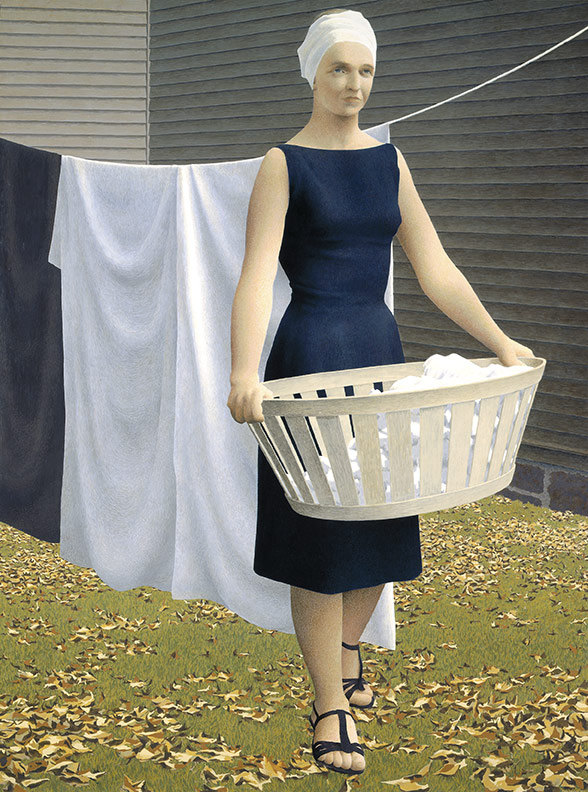
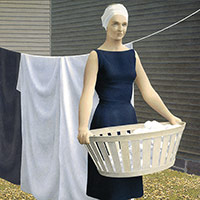
Alex Colville, Woman at Clothesline, 1956-57 glazed oil emulsion on masonite 121.8 x 91.5 cm Purchased 1957 National Gallery of Canada (no. 6683) © A.C.Fine Art Inc
“This simply represents a woman who is carrying clothes out to a clothesline and who I like
to think has not lost her cool.”
—Alex Colville
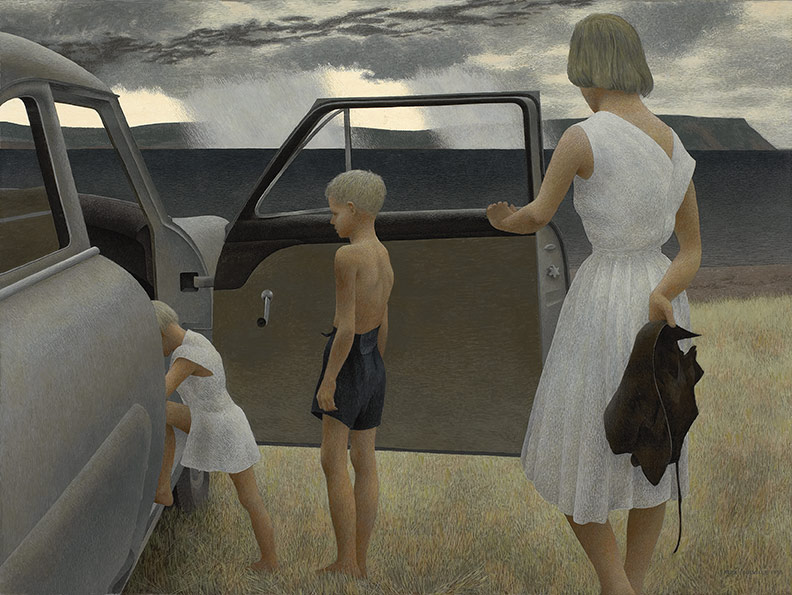
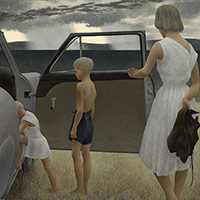
Alex Colville Family and Rainstorm, 1955 glazed tempera on masonite 57.1 x 74.9 cm Purchased 1957 National Gallery of Canada (no. 6754) © A.C.Fine Art Inc
In the 1950s, you see Colville moving more and more toward painting the ordinary scenes that would define his career. He used everyday activities as a way to invite us into images layered with nuance and story. Here, an unexpected summer storm seems to have spoiled a nice day at the beach. This is one of many works inspired by the area where Colville’s wife, Rhoda, had a family cottage. The Colvilles spent every summer there. Rhoda and their four children played on the beach, while Alex spent his mornings painting at her parents’ house in nearby Wolfville, Nova Scotia.
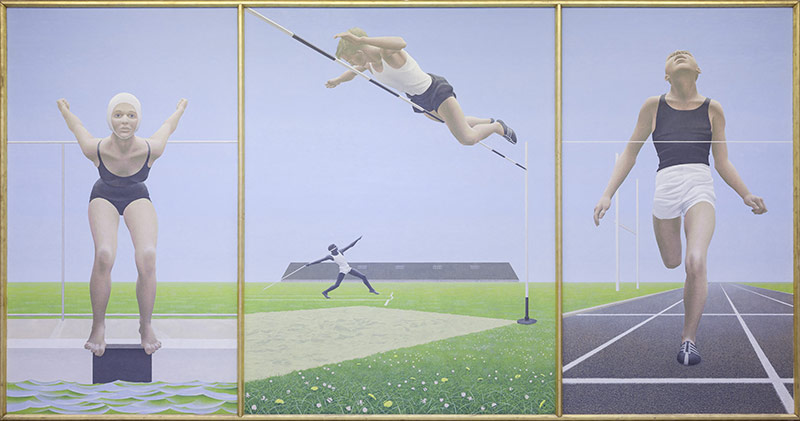
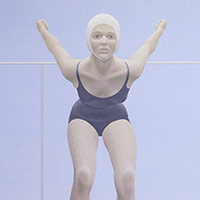
Alex Colville Athletes, 1960 oil and synthetic resin on board 152.0 x 242.0 cm Collection of the Owens Art Gallery, Mount Allison University © A.C.Fine Art Inc
Past, Present and Future: Athletes
For sports-inclined residents of Sackville, New Brunswick, this mural is an everyday reminder of Alex Colville’s life as a student, artist and professor at Mount Allison University. On special loan for this exhibition, these three panels usually hang in the university’s athletic centre. Tradition dictates that award-winning varsity athletes are photographed in front of it. Their portraits hang nearby, a tribute to the past, present and future role Colville’s work plays in the community.
Mount Allison commissioned these panels in 1960.
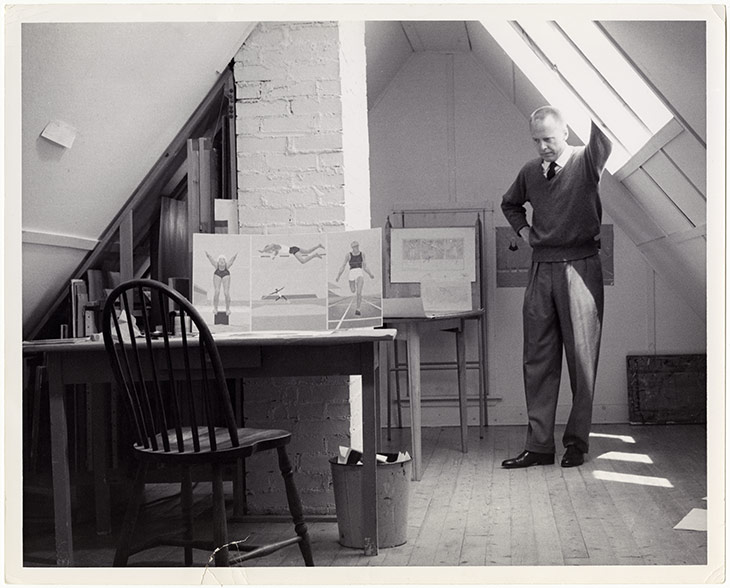
© The Colville Estate, 2014.
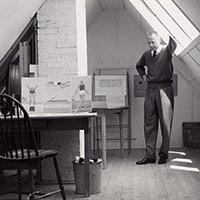
Alex Colville in the attic studio of his Sackville home, around 1960.
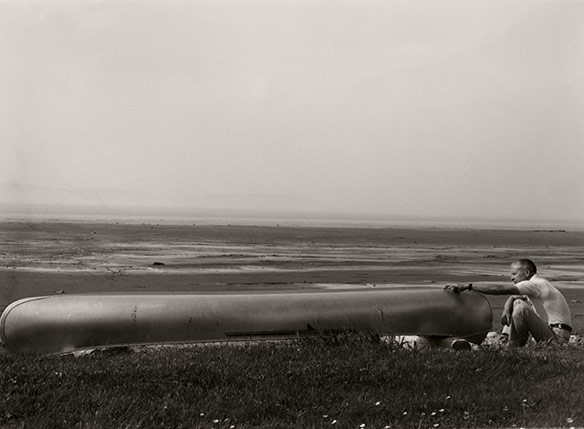
© The Colville Estate, 2014.
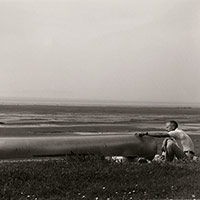
Alex Colville at his cottage on Evangeline Beach, near Wolfville, Nova Scotia, 1980.
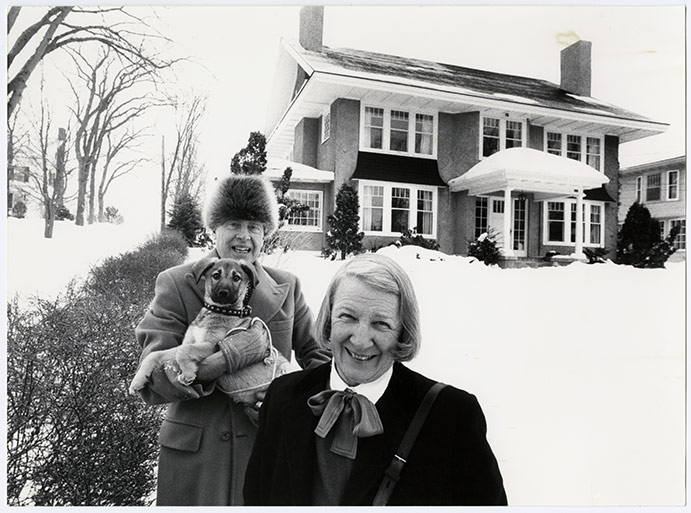
Photo: Guido Mangold, Ottobrunn, Germany.
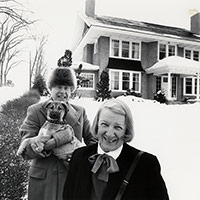
Alex and Rhoda Colville, with Min, outside their home in Wolfville, Nova Scotia, 1988.
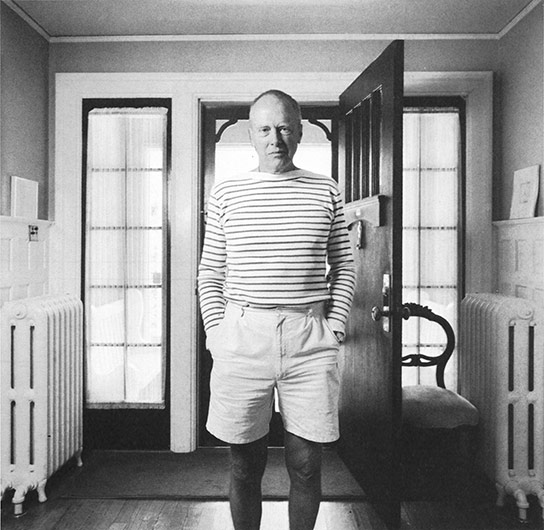
Photo: David Mackenzie/Art Gallery of Nova Scotia. Image courtesy of Steven Slipp.
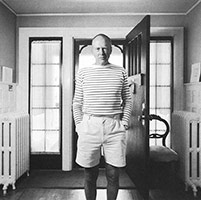
Alex Colville at home in Wolfville, mid-1980s.
Elm Tree at Horton Landing (1956) and Alice Munro
“I think any life can be interesting – I think any surrounds can be interesting. I don’t think I would’ve been nearly so bold as a writer if I had lived in a [bigger] town.” —Alice Munro
“I’ve never had the slightest interest in going to an ‘interesting’ place, because places are equally interesting to me. Wherever I am is reality, things are happening here, and this is ‘as good as it gets,’ as they say.” —Alex Colville
For two artists so focused on the human condition, the solitary, aging tree of Elm Tree at Horton Landing (1956) may seem like a strange point of connection. But as the cover image of Alice Munro’s Progress of Love (1986), Colville’s portrait captures the ambiguities at the core of this Nobel Prize–winning writer’s short stories. Both Munro and Colville investigate the mystery of familiar places and people, and transform the ordinary into the extraordinary. As Colville explains, “It was a portrait of a particular tree, but [also], a tree which I felt had universal significance. I was in a way thinking of the tree as a living being, as an old person, more or less. Of course, the tree is about death and survival.” This idea of an individual surviving in the world – so central to Munro’s life and work – certainly makes this a fitting image to front her book.
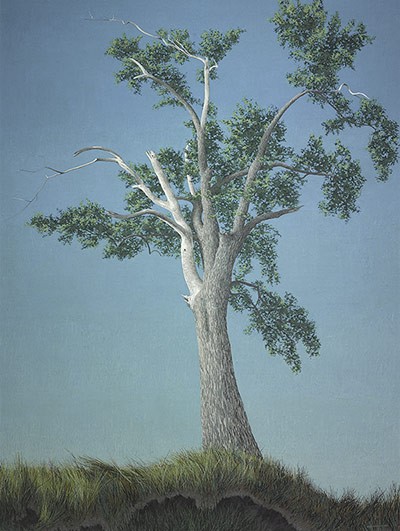
Alex Colville Elm Tree at Horton Landing, 1956 Oil on hardboard Overall: 121.6 x 91.1 cm (47 7/8 x 35 7/8 in.) Collection of the Art Gallery of Ontario. Gift from the McLean Foundation, 1958 ©A.C. Fine Art Inc

Used by permission of McClelland & Stewart, a division of Random House of Canada Limited, a Penguin Random House Company.
Urban geographer Amy Lavender Harris discusses ideas of home and place in the works of Alex Colville and Nobel Prize–winning author Alice Munro. Featuring archival footage of Colville and Munro.
Alex Colville footage from CBC’s Telescope: At Home with Alex Colville, 1967.
Alice Munro footage from CBC’s The Journal, 1990.