Alex Colville
Love, Life and Loss
“Rhoda wants to be buried beside her family, and I of course, want to be buried beside her.” —Alex Colville
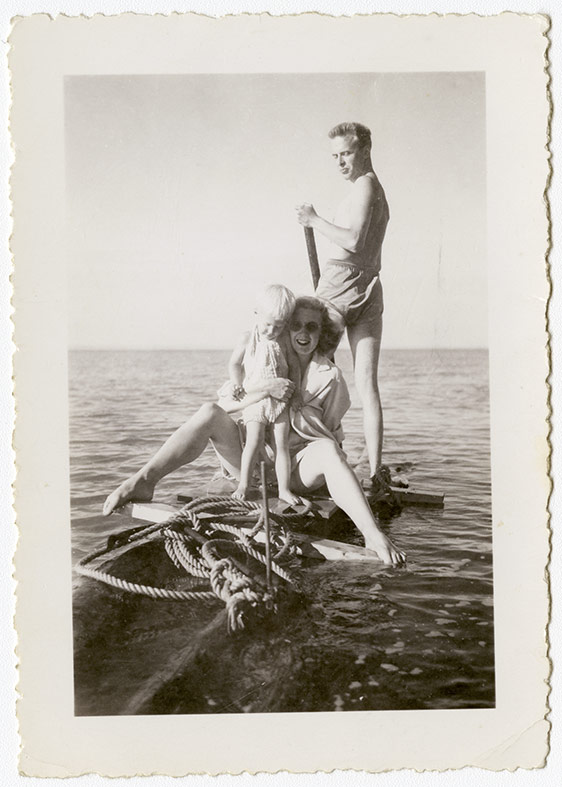
Women appear as central figures in Colville’s scenes of life and landscape. More often than not, the female body you see is based on Colville’s wife, Rhoda Wright Colville (1921–2012). Over their 70-year marriage, Rhoda served as Colville’s faithful partner, model and muse. His devotion to her was equally unfaltering. Even as time transformed her body and whitened her hair, Colville continually and lovingly turned his painterly eye to Rhoda until the very end. Gathered together in one room, these paintings could be seen as poignant memories of a couple’s profound connection over seven decades. But, more than that, Colville has also created images that explore issues of power and trust, vulnerability and mortality, life and love.
Featured Images
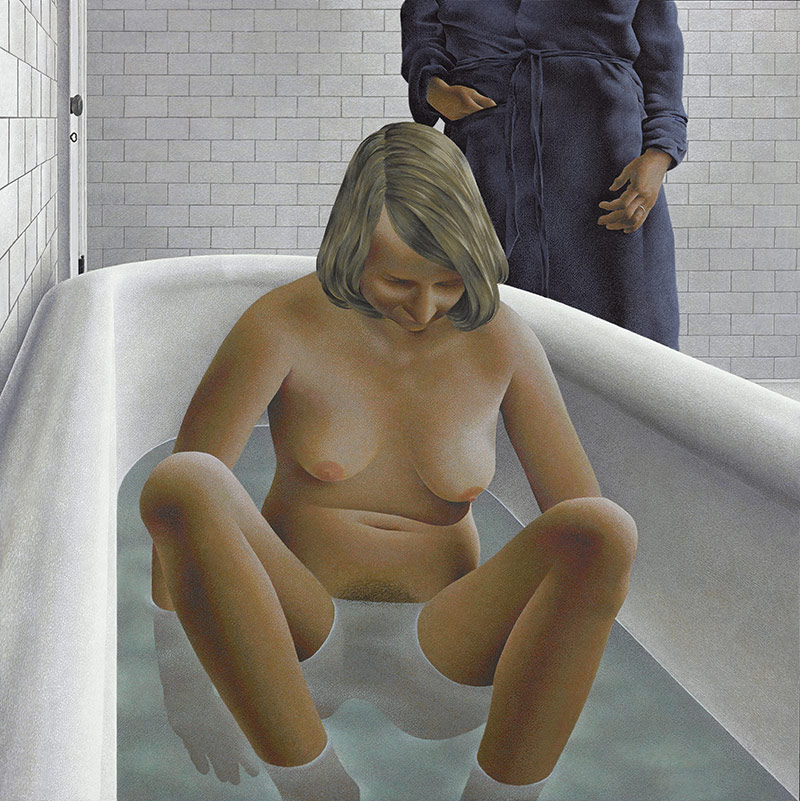
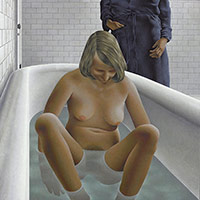
Alex Colville, Woman in Bathtub 1973 Acrylic polymer emulsion on particleboard 87.8 × 87.6 cm Collection of the Art Gallery of Ontario, purchase with assistance from Wintario, 1978 © A.C. Fine Art Inc.
This image explores the intimacy that exists between couples. It is a portrait of Colville and his wife, but the painting also speaks to universal issues of love, vulnerability and shared lives. Alex and Rhoda had four children together: Graham, John, Charles and Ann. As in so many families at the time, Rhoda ran the household while Alex worked. “It was Rhoda who spent so much time with the children,” Alex said of his wife, who had given up her creative practice (she also had a fine arts degree) to be a wife and mother. Rhoda was Colville’s lifelong inspiration.
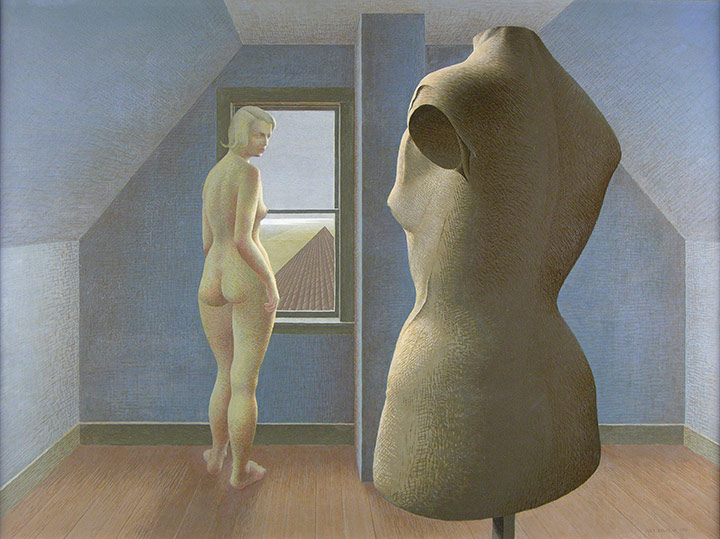
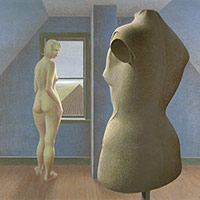
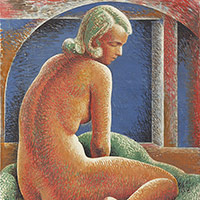
Alex Colville, Nude and Dummy 1950 Glazed gum arabic emulsion on board 60.9 × 81.2 cm Collection of the New Brunswick Museum, purchased from the artist, 1951 © A.C. Fine Art Inc.
Colville called this “his first good painting.” As he recalled, “I knew it was good, you know. I knew at age 30 for the first time I'd done something really quite good. I'd never felt this way about anything I'd done before.” In 1949, Alex and Rhoda bought a home on York Street in Sackville. Experiencing a bit of an artistic rut, Colville decided to spend the summer working on home renovations. The building project inspired a transformative breakthrough for the artist. Precise planning, mathematical equations and geometric connections became the hallmarks of his work.
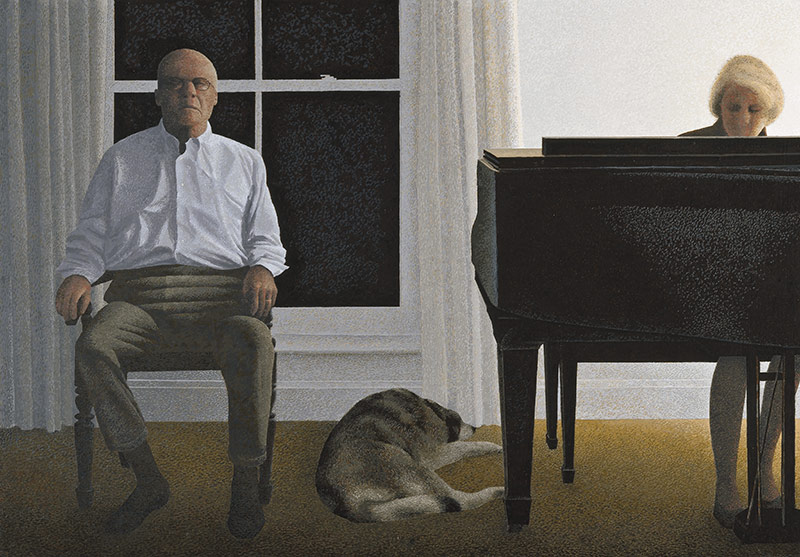
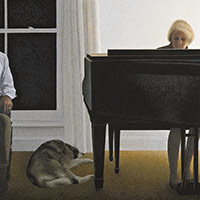
Alex Colville, Living Room 1999–2000 Acrylic on Masonite 41.8 × 58.5 cm National Gallery of Canada, purchased 2000 © A.C. Fine Art Inc.
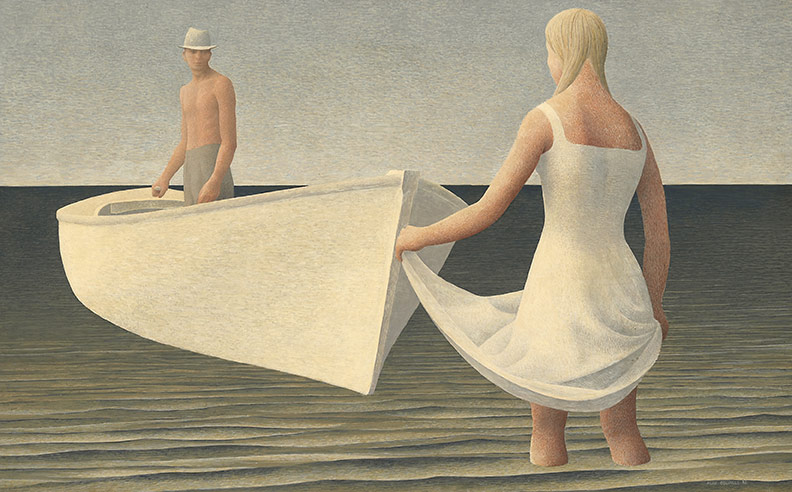
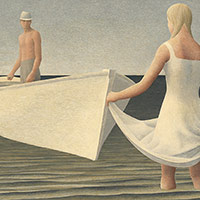
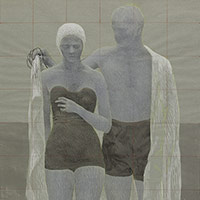
Alex Colville, Woman, Man, and Boat 1952 Glazed tempera on Masonite 32.3 × 51.3 cm National Gallery of Canada, purchased 1954 © A.C. Fine Art Inc.
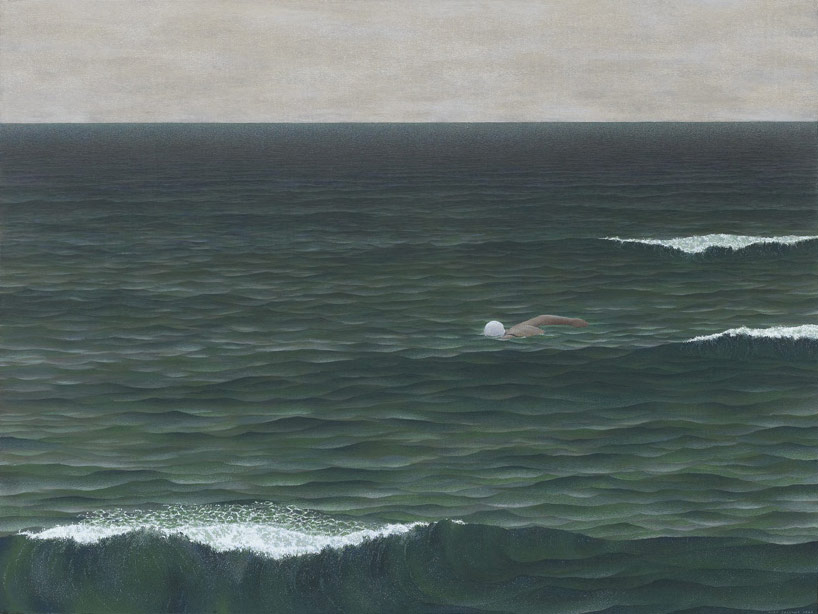
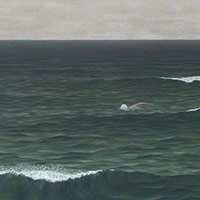
Alex Colville, Swimmer 1962 Egg tempera on Masonite panel 53 × 70.8 cm Collection of the Art Gallery of Ontario, gift of Dr. Helen J. Dow, 1991 © A.C. Fine Art Inc.
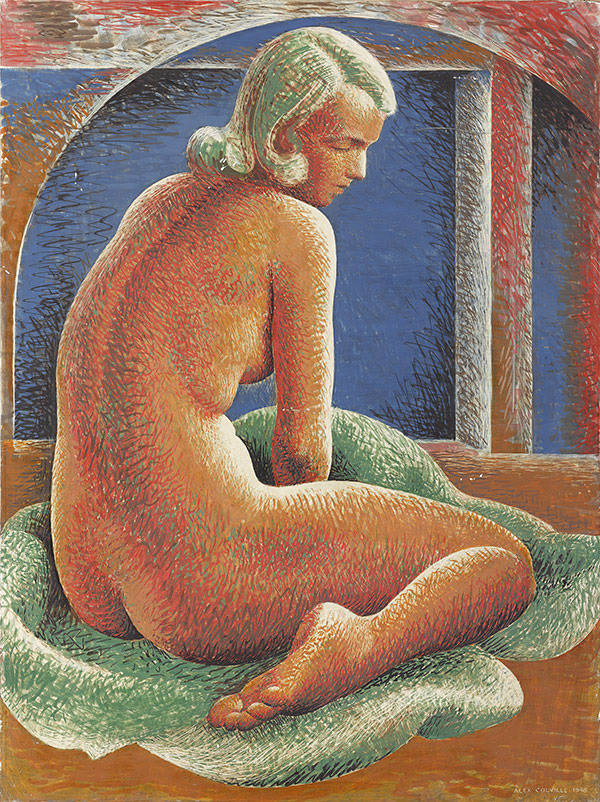
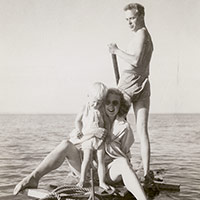
Colville’s wife, Rhoda, was an avid swimmer who swam into her late 80s. She often appears in his work in a swimsuit: on a boat, diving into a swimming pool, emerging from the ocean. You could argue it’s the artist returning to a classical subject: the female body. But you could also see these as portraits of an empowered woman, independent and commanding the scene with her self-assured athleticism.
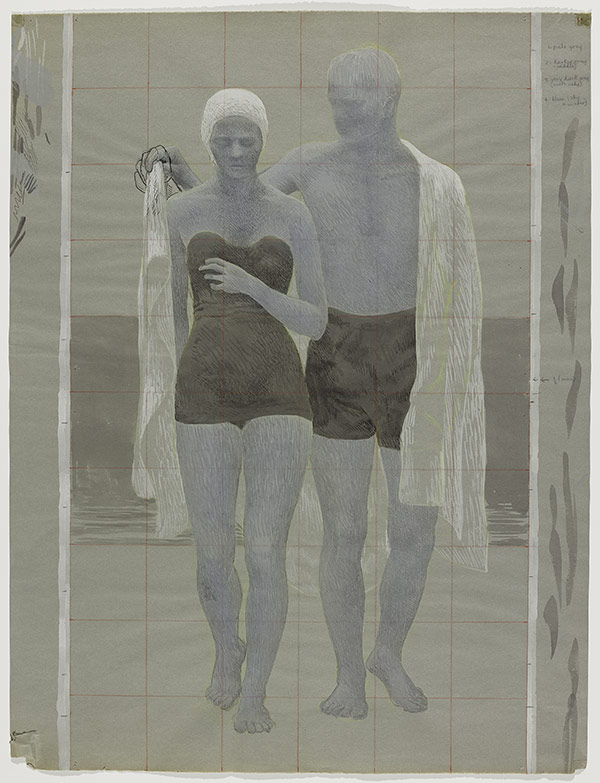
Alex Colville, Study for After Swimming 1955 Ink and graphite on grey paper 63 x 48 cm Courtesy of A.C. Fine Art Inc. © A.C. Fine Art Inc.
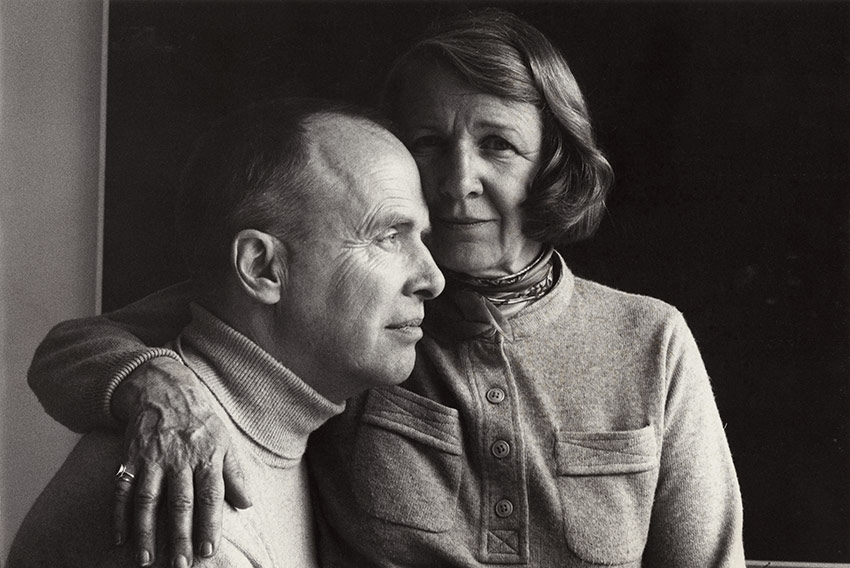
Photo by Guido Mangold, Ottobrunn, Germany. Courtesy of the Colville Estate.
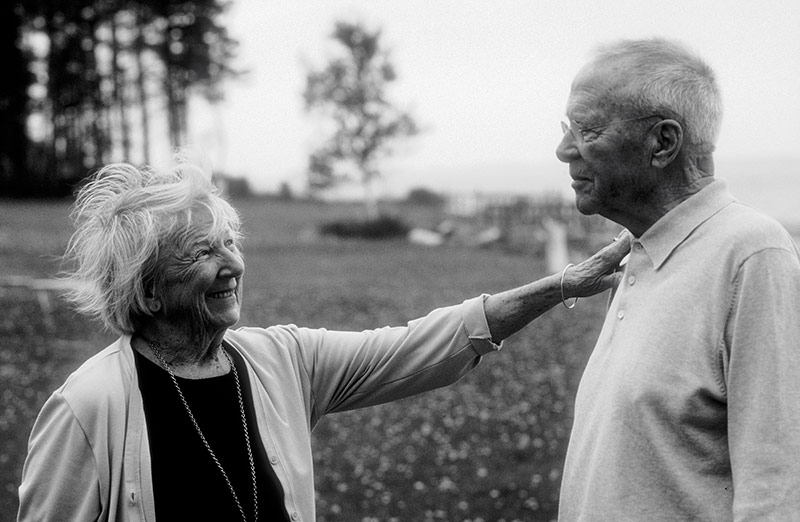
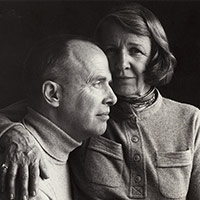
Alex and Rhoda, 1976.
© The Colville Estate, 2014.
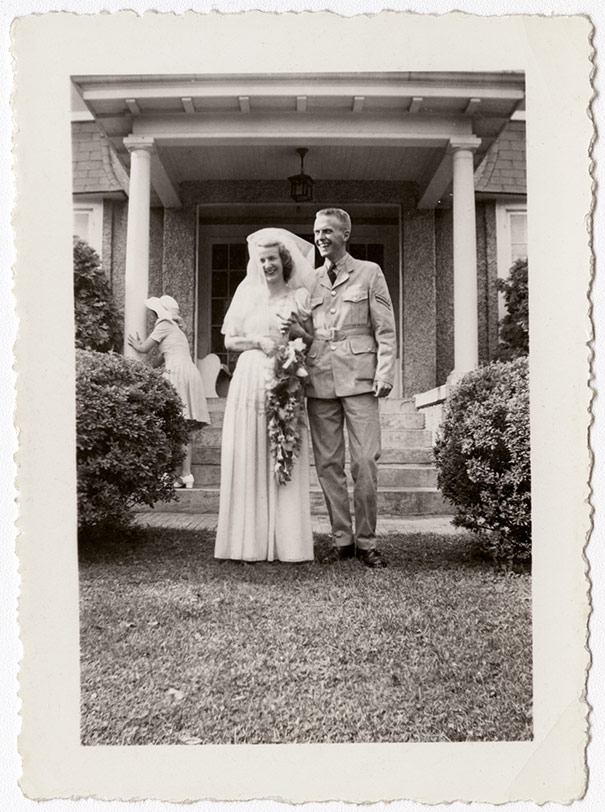
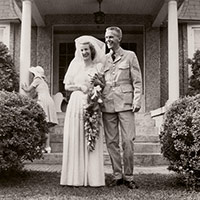
Alex and Rhoda Colville on their wedding day in 1942, in front of Rhoda’s family home in Wolfville, Nova Scotia, where the Colvilles themselves lived from 1973 until 1998.
© The Colville Estate, 2014.
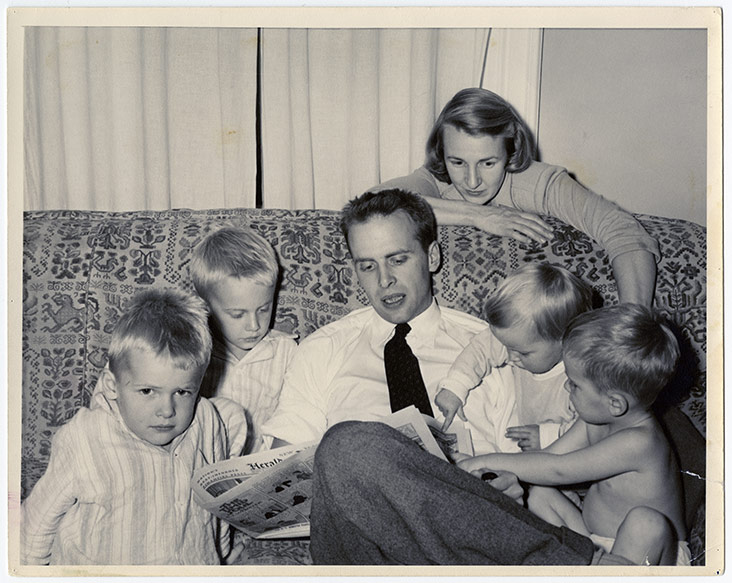
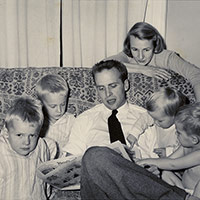
A Colville family portrait, 1951. From left to right: John, Graham, Alex, Rhoda, Ann and Charles.

Couple on Beach (1957) and Stories We Tell (2013)
“He never wanted to be away from her. She had the spark of life.” —Alice Munro, The Bear Came over the Mountain
This painting is classic Colville: an uncertain scene that raises questions about intimacy and relationships as the artist turns our view to a private moment between two people. As with many of his works, Colville bases these figures on himself and his wife, Rhoda. It is tempting to see this as a portrait of husband and wife. But these figures, their faces obscured, could also be any couple, on any beach, at any time. The piece is paired with selected scenes from Canadian filmmaker Sarah Polley’s Stories We Tell, a documentary about the search for meaning and connection with lost loved ones, specifically Polley’s own mother. Exploring issues of trust, both works blur the lines between truth and fiction by calling attention to how we see, how we remember and how we love. Both Colville’s painting and Polley’s film provoke the question: what does it mean to know another person?
Alex Colville Couple on Beach, 1957 casein tempera on masonite 73.4 x 96.4 cm Purchased 1959 National Gallery of Canada (no. 7744) © A.C.Fine Art Inc
Courtesy of Sarah Polley
Alex and Rhoda Colville’s daughter, Ann Kitz, talks about her parents’ profoundly deep relationship. Featuring archival footage of Alex and Rhoda from the documentary Studio: The Life and Times of Alex Colville, 2000.
Archival footage courtesy of 90th Parallel Productions Ltd., Toronto.